How to choose the right storage stacker crane to improve operations?
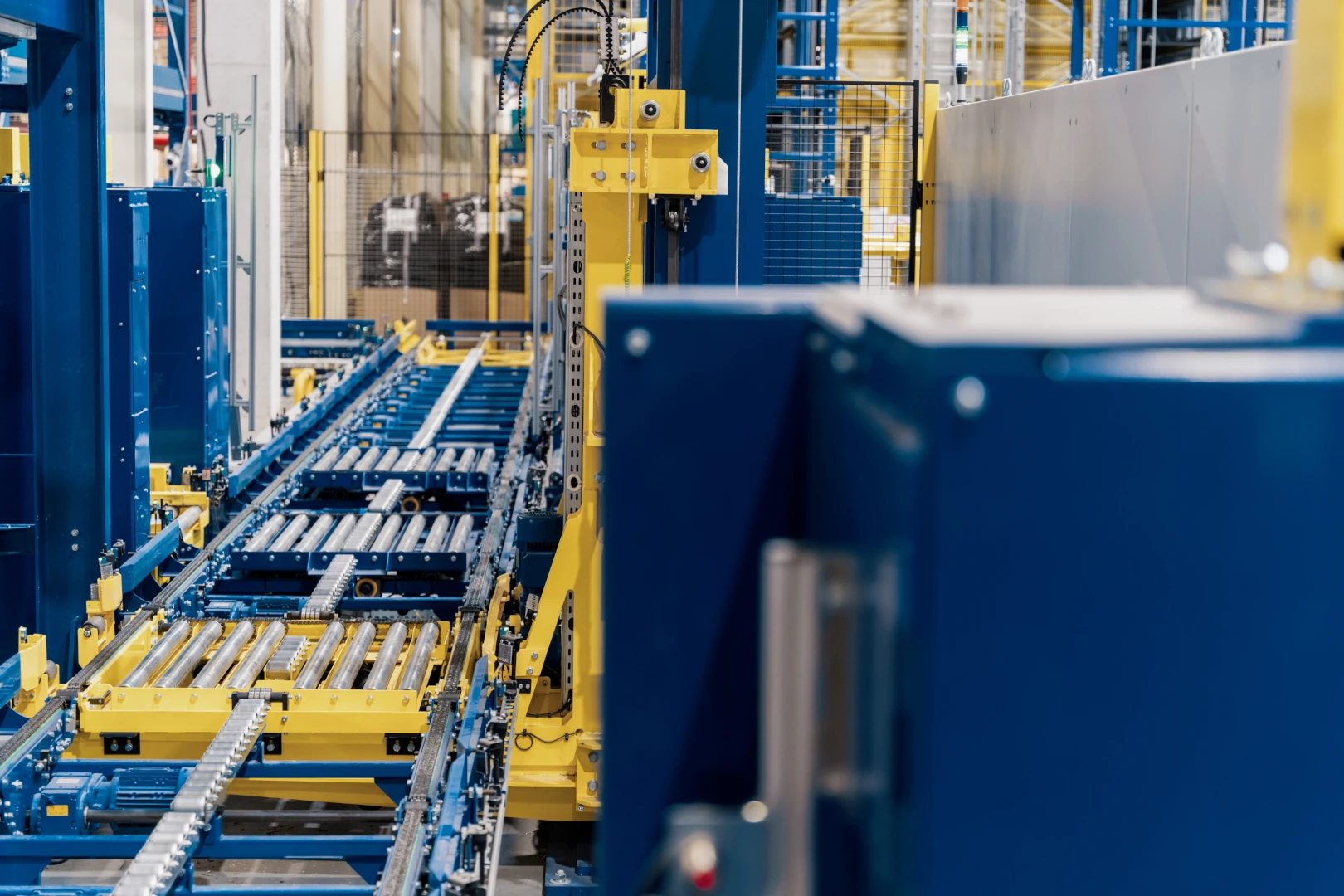
Did you know that the first stacker cranes — automatic devices for handling high-bay racking systems — were already being introduced back in the 1960s? They provide invaluable support if you want to speed up operations, reduce errors, and make better use of space. The only question is: how do you choose the right stacker crane when there are so many options available?
Stacker cranes – types
There is no single universal stacker crane — and that is good news. It means that the device can be matched to the type of loads and the specific nature of a given business. Some stacker cranes are suited to heavy and large items such as sheets, profiles, or pipes, while others work best with small goods such as cartons, containers, or trays.
The first step, therefore, is to analyse the specific situation in the warehouse and select the best possible solution. Ask yourself the following questions.
-
What types of loads will be stored in the warehouse — heavy and large items, or small goods such as cartons, containers, and trays?
-
What are the dimensions and weight of the most frequently handled goods?
-
What is the permitted storage height in the racking and the available warehouse space?
-
How frequently are goods received, moved, and dispatched — what is the daily operation volume?
-
Does the warehouse require a specialised stacker crane, e.g. for panels, coils, tyres, or non-standard pallets?
-
What are the expectations regarding the automation of logistics processes and integration with other systems?
-
What criteria are most important for the company — for example, cost reduction?
Stacker cranes – what to look for when choosing one?
How do stacker cranes work? Above all, they use software that controls every movement of the device, indicates the storage location, and optimises warehouse operations in real time.
This is precisely why stacker cranes are a major asset in ASRS — Automated Storage and Retrieval Systems. They are responsible for the safe movement of loads, often without an operator, which is an additional advantage.
When selecting a stacker crane, do not base your decision on price alone. Specific parameters matter:
-
load capacity — from several hundred kilograms to even a few tonnes,
- working height — some systems service racking reaching several dozen metres,
-
operating mode — manual, semi-automatic, or fully automatic,
-
WMS/ERP integration — important for efficient warehouse management,
Where do stacker cranes give you the edge?
The greatest strength of these devices lies in space utilisation. They operate where people and traditional equipment have limited capabilities — in narrow aisles and at great heights. This allows you to gain additional warehouse space without expanding the building. On top of that, safety improves, as fewer people are present in high-bay storage zones, which means a lower risk of accidents.
Read also: What exactly is an automated warehouse?
Stacker cranes at MPL Techma
For us, a stacker crane is just one piece of a larger puzzle — often alongside racking, conveyors, picking stations, and robots. This means you do not adapt to the technology. The technology adapts to you.
What can we design for you?
|
Stacker crane type |
Application |
Load handled |
Key features / benefits |
|
Single-mast pallet stacker crane (scalable) |
Automated storage and transport in racking systems |
Pallets up to 1,200 kg (euro, industrial, non-standard) |
Scalability, versatility, space efficiency, high throughput |
|
Storage and transport of panels |
Panels (e.g. furniture boards, sandwich panels) |
Safe handling of delicate materials, stability, minimised damage |
|
|
Handling of wound materials |
Coils (e.g. steel, plastics) |
Tailored to the tyre industry, precision, high load capacity |
|
|
Transport and storage of tyres |
Tyres (raw and finished) |
Robust construction, high throughput, reliability in continuous operation |
|
|
High-speed warehouse operations |
Cartons, containers, trays |
High operational dynamics, precision, ideal for small loads |
Each of these solutions can operate as part of a larger ASRS system, fully automated and integrated with the warehouse.
Implementing stacker cranes is not a cost — it is an investment that pays for itself quickly:
-
you increase warehouse throughput several times over,
-
you reduce errors and losses,
-
you lower labour costs,
-
you make maximum use of the available space,
-
you improve team safety.
Read also: How to choose the right industrial conveyor for your company?
At MPL Techma, we analyse the warehouse, processes, and goals — then design a solution that supports them. Whether you are building a new facility or modernising an existing space. Have questions? Get in touch — we will be happy to walk you through all the possibilities!
FAQ – Stacker cranes
1. What types of stacker cranes are there and when should they be used?
Pallet stacker cranes, triple-mast, twin-column, and MiniLoad cranes are the basic types of warehouse stacker cranes. The choice depends on the storage depth, the type of load units, and the product range of the business.
2. What is the difference between manually operated and fully automated stacker cranes?
Manually operated stacker cranes allow an operator to retrieve individual load units. Fully automated stacker cranes use a warehouse control system and optimise the flow of goods in cold storage or production warehouses.
3. How do stacker cranes work alongside forklifts and pallet shuttle vehicles?
Forklifts or drive-in vehicles work alongside stacker cranes when depositing and retrieving load units. A pallet shuttle vehicle moves inside the racking, enabling maximum utilisation of warehouse space.
4. How do stacker cranes contribute to optimising production warehouses?
Stacker cranes speed up the process of depositing and retrieving goods, reducing operator working time. They also allow control over the flow of goods and increase company efficiency through WMS integration.
5. Are telescopic stacker cranes suitable for different types of products?
Yes, telescopic stacker cranes are ideal for handling a variety of load units, including pallets, coils, and packaged products. Thanks to their grippers and structural design, it is possible to safely transport goods of significant weight or non-standard dimensions.
6. How does the structural design of a stacker crane affect safety and performance?
The device's construction — for example twin-column or triple-mast — affects the stability and operating speed of the stacker crane. Robust forks and an appropriate gripper allow load units to be safely deposited and retrieved in cold storage and production warehouses.
7. Can stacker cranes operate in demanding conditions, such as low temperatures?
Yes, stacker cranes are adapted for use in cold storage warehouses and production facilities where temperature may affect products. Appropriate materials and a WMS warehouse control system ensure reliable operation while optimising the flow of goods.
8. What parameters should be considered when selecting a pallet stacker crane?
The key factors are load capacity, maximum storage height, crane type, and compatibility with the warehouse floor. Integration with the WMS system and the possibility of coordinating with forklifts or other transport equipment should also be taken into account.
9. Can stacker cranes handle individual or non-standard load units?
Yes, advanced manually operated or fully automated stacker cranes can store, retrieve, and transport both individual and non-standard load units. The warehouse control system allows maximum utilisation of warehouse space in a given facility.
10. How do stacker cranes support warehouse management and logistics in a company?
Stacker cranes work in conjunction with WMS systems. They optimise the depositing and retrieval of goods and the flow of load units. Thanks to them, a company can increase efficiency, improve workplace safety, and make better use of its available warehouse space.